

How India Managed 111,000 kg of Waste at the ICC Men's T20 World Cup 2026
Updated: May 20
What happens after 50,000 cricket fans leave a stadium? At the ICC Men’s T20 World Cup 2026, India answered that question with action. Through the #MaidaanSaaf campaign, over 111,000 kg of waste was managed across five cities with an impressive 84.64% segregation rate. This wasn’t just cleanup, it was a high-pressure, real-time system tackling massive waste surges, fan behavior, and operational challenges. From zero-waste benchmarks in Ahmedabad and Chennai to hard lessons in Kolkata, the campaign revealed what sustainable sports events truly demand. It’s a powerful example of how planning, accountability, and awareness can turn even the biggest crowds into part of the solution.
When a cricket stadium fills up, the conversation is always about runs, wickets, and DRS reviews. What nobody talks about, at least not loudly enough, is what 50,000 people leave behind when the last ball is bowled and the crowds pour out into the night.
At the ICC Men's T20 World Cup 2026, that question had a serious, structured answer for the first time at this scale. Across five Indian host cities, a multi-stakeholder waste management initiative called #MaidaanSaaf managed 111,074.11 kg of total waste, achieved an average segregation rate of 84.64%, diverted 94,001 kg from landfill, and sensitised over 932,000 attendees to responsible waste behaviour. To put the scale in perspective, the T20 format generated approximately seven times more waste than the Women's ODI World Cup 2025, 111,074 kg compared to 15,553 kg, largely because T20 crowds are denser, consume more food and beverages, and generate waste in sharp, unforgiving surges rather than gradual build-ups.
This is not a feel-good story about putting a few extra bins in a stadium. It is a ground-level account of what sustainable sports events in India actually look like when the systems are designed with intent, implemented under pressure, and honest about where they fall short.
Table Of Contents
What Was #MaidaanSaaf and Why Did It Need to Exist?

The Problem Nobody Talks About: Waste at Cricket Scale
A T20 match lasts three to four hours. Unlike an ODI, which gives housekeeping teams a gradual seven to eight hour window to stay on top of waste, a T20 generates two sharp spikes, one at innings break lasting roughly 20 minutes, and one at the post-match crowd exit. There is no recovery window. If a bin is missing, if a Safai Saathi is untrained, if a truck arrives late, none of that can be corrected once 50,000 people are already inside.
The data makes this even starker. T20 crowds had 2.4 times more attendees than the Women's ODI format but generated six times more waste. High-energy fan behaviour, littering impulsively during wickets, boundaries, and crowd waves, is as much a waste driver as inadequate infrastructure. This is a behavioural challenge as much as an operational one, and it needed a campaign designed for both. If you want to understand how large sports events in India manage waste and what the ground-level reality looks like, the contrast between formats tells that story more clearly than any single metric.
See how Maidaansaaf and Greenmyna are making the T20 Men's World Cup greener and cleaner- watch here 👉
The Campaign Architecture
#MaidaanSaaf was led by Anandana, The Coca-Cola India Foundation, in partnership with the ICC, Ek Saath (The Earth Foundation), and Greenmyna. The campaign operated across five stadiums covering 30+ matches in Mumbai, Chennai, Delhi, Kolkata, and Ahmedabad.
The structure rested on four operational pillars.
The first was Segregation Support, overseeing waste segregation and strengthening recycling streams at all five venues.
The second was Vendor Empowerment, training housekeeping and F&B vendors through awareness programmes and incentives.
The third was Awareness and Sensitisation, an IEC (Information, Education, Communication) programme that reached 845,000+ stadium attendees directly. The fourth was Communication Management, real-time coordination between all on-ground stakeholders using WhatsApp groups, designated points of contact, and match-day monitoring protocols.
Operationally, the campaign ran in three phases. Pre-match recce visits handled need assessment, segregation zone setup, staff training, Safai Saathi kit distribution, and scoreboard messaging. On match day, Greenmyna teams ran bin deployment checks, coordinated with housekeeping in real time, and oversaw live waste segregation at a central zone in each stadium. Post-match, a Match Day plus one collection was conducted to maximise recovery, followed by data collection from all waste pickup partners and a Green Champion Felicitation Ceremony recognising ICC officials, stadium teams, and on-ground workers.
The Numbers That Define What Happened
The data across T20 and ODI formats tells a clear story about why stadium waste management in India cannot be treated as a one-size-fits-all operation.
Metric | ICC Men's T20 WC 2026 | Women's ODI WC 2025 |
Total Waste Managed | 111,074.11 kg | 15,553 kg |
Waste Diverted from Landfill | 94,001 kg | 11,400 kg |
Dry Waste Recycled | 51,420 kg | 7,000 kg |
Wet Waste Composted | 17,260 kg | 4,360 kg |
Attendees Sensitised | 932,000+ | 350,000+ |
Average Segregation Rate | 84.64% | 73.4% |
Waste Surge Pattern | Sharp peaks during innings breaks and post-match | Gradual build-up across the day |
Format Duration | 3 to 4 hours | 7 to 8 hours |
Seven times more waste. The same country. The same sport. A completely different operational reality. That number alone makes the case for format-specific sustainability planning at every future cricket event in India.
City by City: What Actually Happened on the Ground
Each of the five cities told a different story. Same campaign, same four pillars, vastly different institutional realities.
1. Ahmedabad and Chennai: What a 100% Benchmark Looks Like
Narendra Modi Stadium in Ahmedabad handled 315,325 spectators across seven matches, generated 44,127 kg of waste, and achieved 100% landfill diversion. This is the world's largest cricket stadium. The result was not luck. A cooperative GCA, a 6-bin segregation system with 12 Safai Saathis at the central podium, reusable 20-litre water cans at free water stations from Match 1, and hospitality partners who agreed to collect their own wet waste on match day, these were deliberate design choices made before the tournament began. Ahmedabad is now the benchmark for what large-scale zero waste events in India can achieve.
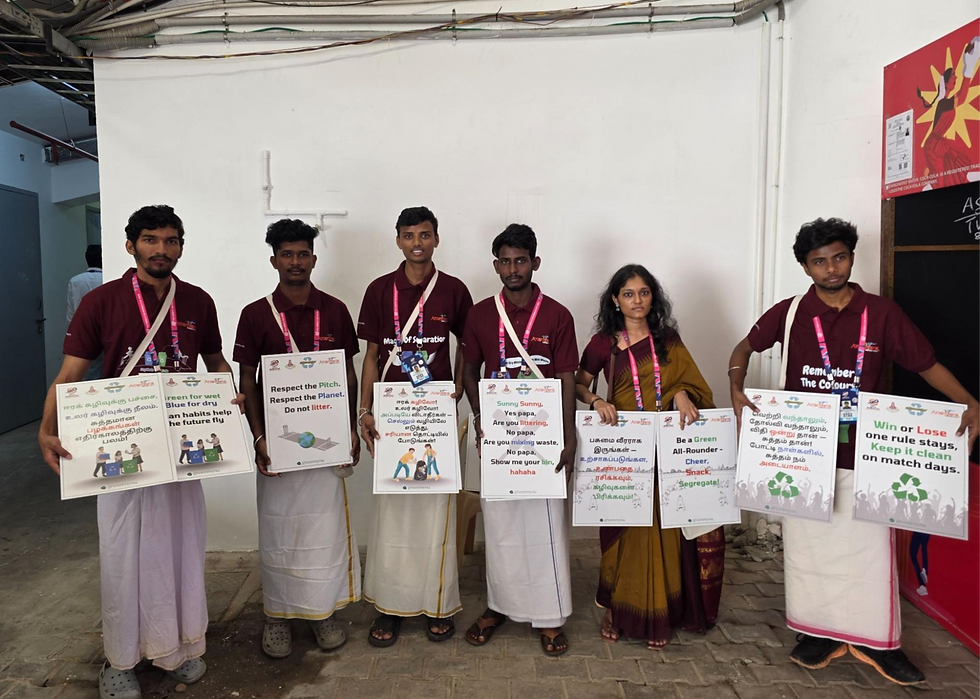
Chennai's MA Chidambaram Stadium (Chepauk) matched it with 100% segregation across 148,481 spectators and 18,547 kg of waste managed. Food stall vendors used zero single-use plastics. Hospitality teams independently managed their own dry and wet waste streams. Bin placement at entry gates dramatically reduced littering in the stands. Most significantly, TNCA formally invited the Greenmyna team to their office to discuss and institutionalise waste segregation protocols, a moment of genuine governance buy-in that no amount of on-ground effort can manufacture. All rejected waste was routed to the Municipal Corporation for bio-mining, with remaining material sent to cement factories for Refuse-Derived Fuel generation.
The real lesson from both cities: 100% is achievable. But it requires institutional buy-in that is genuine rather than performative.
2. Mumbai and Delhi: Strong Performance, Honest Gaps

Wankhede Stadium in Mumbai managed 24,323 kg of waste across 163,582 spectators and achieved a 74.96% segregation rate. The 6-bin system worked. A small but meaningful operational insight: keeping swing bin lids open, after observing that crowds hesitated to touch lids, immediately reduced overflow in high-footfall areas. For the India versus England final, 50 additional bins were deployed and sustainability influencers amplified the campaign's reach significantly.
The operational gap was harder to miss. An uncleared segregation area combined with bulk food waste dumped by F&B vendors after Match 1 caused severe odour complaints from neighbouring buildings by Match 2. Stadium officials responded by restricting post-match segregation to match hours only, which directly limited recovery efficiency for the remainder of the tournament. The key learning is straightforward: segregation areas must be cleared and match-ready at least one full day before each fixture, and vendors must be prohibited contractually from dumping excess food at the segregation zone.
Delhi's Arun Jaitley Stadium (DDCA) achieved 88% segregation across 100,338 spectators with a total waste figure of 5,687 kg. A sustainability influencer's plogging session during the match break cleared an entire stand and visibly motivated spectators around them. The DDCA facility processed 166 kg of waste through in-house composting across three matches. Robinhood Army received 150 food plates redistributed from the hospitality team at Match 2, a simple but replicable food recovery intervention.
The challenge at Delhi was structural. Up to four temporary dumping points were created by housekeeping staff instead of routing waste to a single designated segregation point. Hospitality teams dumped loose bags of liquid food waste directly in the segregation area, creating spillage, hygiene risks, and safety hazards for Safai Saathis. One waste stream issue discovered during operations involved water bottles used as substitutes for toilet access, a serious hygiene and worker safety concern that points to inadequate fan infrastructure at a tournament of this scale.
3. Kolkata: Where Institutional Resistance Became the Real Challenge

Eden Gardens was the most contested performance of the campaign. The stadium hosted 204,977 spectators across seven matches and recorded a 44.05% segregation rate, the lowest among the five cities, with a note in the report that waste figures were arrived at from unverified sources.
The core issue was not bins or infrastructure. Housekeeping staff at Eden Gardens removed unsegregated waste via trucks multiple times before the Greenmyna team was informed or mobilised, directly undermining both segregation and waste accounting. Dry waste figures for the NZ versus SA final match (33,533 spectators) recorded only 1,048 kg compared to 1,265 kg for the 65,354-spectator West Indies versus India match. The numbers do not hold up, and the report does not pretend otherwise.
From Match 5 onwards, coordination improved after CAB authorities created a WhatsApp group and appointed two points of contact. A felicitation ceremony attended by senior CAB officials opened formal conversations about taking sustainability seriously. Progress was real but late. The key learning: Eden Gardens is a structural and institutional challenge, not an operational one. Contractual instruction from CAB to the housekeeping team, in writing, before the tournament begins, is non-negotiable at this scale.
What the T20 Format Reveals About Sustainable Sports Events in India?
The gap between T20 and ODI waste generation is not just a volume difference. It reveals four fundamental planning principles that should now shape every future sustainable sports event in India.
There is no recovery window. Everything, bins, trained staff, designated segregation zones, vendor briefings, must be in position before gates open. What gets missed before the match stays missed for the entire match.
Housekeeping must be surge-ready, not schedule-driven. Two waste spikes define the T20 match: innings break and post-match exit. Rosters and clearance protocols built around fixed clock times simply fail at this format's pace. The evidence-based bin density from this campaign: a minimum of one bin per 80 fans at venues with 50,000 or more capacity.
Fan behaviour is a sustainability variable, not a background condition. Quizzes, performance-based engagement, and local language IEC activities outperformed static banners consistently. Chennai volunteers in traditional attire and waste-to-photo booth installations at Mumbai both drove measurably higher engagement. Passive signage does not change behaviour at cricket scale.
The circular economy needs to be visible. PET bottles collected across stadiums were converted into national flags used during match ceremonies, a circular economy moment seen by hundreds of thousands of fans. Sustainable beverage cups were introduced as collectible merchandise to reduce single-use plastic consumption. When the waste journey ends in something fans can see and connect to, the behaviour change sticks.
The Circular Economy in Action
The waste that left these five stadiums did not simply disappear into a landfill. 51,420 kg of dry waste was recycled, with PET bottles and paper recovered for material processing. 17,260 kg of wet waste was composted, turning organic stadium waste into circular value. Chennai's reject waste was bio-mined and the remainder converted into Refuse-Derived Fuel for cement factories. The Greenmyna team in Ahmedabad conducted a site visit to the Nepra segregation facility so the team could trace the full waste journey from stadium collection to zero landfill outcome, an act of transparency that matters when building long-term institutional trust.
This campaign also demonstrated alignment with four UN Sustainable Development Goals in operational terms, not just in project documentation. SDG 11 (Sustainable Cities), SDG 12 (Responsible Consumption and Production), SDG 13 (Climate Action), and SDG 17 (Partnerships for Goals) were each reflected in measurable outcomes across the five cities. Sports events have a real opportunity to cut their carbon footprint beyond waste alone, and the SDG alignment achieved here points directly toward what that broader commitment can look like in practice.

Every event organiser, sports body, and city administrator working on stadium waste management in India can take these five principles directly from the #MaidaanSaaf implementation.
Map bin density to footfall, not floor area. One bin per 80 fans at 50,000-plus capacity venues. Surge-capacity trolley bins at concourses. Liner changes tied to innings timing, not fixed clock schedules.
Make central segregation a contractual requirement. ICC must embed pre-built segregation zones into hosting agreements before the tournament calendar is finalised. Temporary dumping points should be eliminated at the contract stage, not discovered on match day.
Train every layer, not just supervisors. F&B staff, security personnel, volunteers, and ticketing teams all need a 10-minute pre-match refresher. Vendor compliance improved match-by-match at every venue where training was consistent and repeated.
Mandate source-level plastic elimination. F&B licences must include a single-use plastic prohibition clause. Aqueous-coated cups as the default option, not an alternative. Food recovery partners pre-contracted for all concessionaires above a defined volume threshold.
Make waste data a hosting obligation. The single biggest unresolved challenge from this campaign is the refusal of hospitality and F&B partners to share waste generation data. At T20 scale, those untracked volumes are proportionally larger than at any other format. ICC must require verifiable waste data submission from all partners as a condition of their event participation, no data, no licence.
Conclusion
#MaidaanSaaf proved that large-scale waste management at cricket events in India is not just possible, it is practical and repeatable. Achieving an 84.64% segregation rate across major venues like Narendra Modi Stadium and Eden Gardens came down to strong planning, trained teams, real-time coordination, and partners willing to stay accountable.
The next step is turning these lessons into standard practice across sports venues, city events, and public gatherings. Clean events cannot depend on goodwill alone. They need systems, clear responsibilities, and long-term commitment.
Greenmyna is helping build that model for the future. Connect with Greenmyna to explore how smarter waste systems can make large events cleaner, more efficient, and more sustainable.
Frequently Asked Questions
1. What was the #MaidaanSaaf campaign at the ICC Men's T20 World Cup 2026?
#MaidaanSaaf was a large-scale waste management initiative implemented across five Indian host stadiums during the ICC Men's T20 World Cup 2026. Led by Anandana with partners including Greenmyna, Ek Saath Foundation, and the International Cricket Council, the campaign managed 111,074.11 kg of waste and achieved an 84.64% segregation rate.
2. How much waste was generated during the ICC T20 World Cup 2026 in India?
The campaign managed 111,074.11 kg of waste across five cities. This included 51,420 kg of dry waste recycled, 17,260 kg of wet waste composted, and 94,001 kg diverted from landfill.
3. Which stadium had the best waste management performance?
Narendra Modi Stadium and MA Chidambaram Stadium were the standout performers, both achieving 100% waste segregation and 100% landfill diversion.
4. How can cricket events in India achieve zero waste?
Zero-waste cricket events need strong planning, enough bins, trained staff, vendor rules on single-use plastics, central segregation zones, and verified waste tracking. The campaign showed that even very large stadiums can achieve zero landfill diversion with the right systems in place.
5. What was Greenmyna’s role in sustainable sports events?
Greenmyna served as the on-ground implementation partner for the campaign. The company managed segregation systems, coordinated waste workers, monitored match-day waste, ran awareness activities, and tracked impact data across all five venues.


Comments