

From Chaos to Compost: How Large Sports Events in India Manage Waste (and What We Learned at CWC 2025 and 2026)
Large sports events in India used to leave behind mountains of mixed waste, but that’s changing fast. What we saw at the 2025 and 2026 cricket tournaments is a clear shift from simple cleanup to smart, real-time waste management. With better bin placement, on-ground volunteers guiding fans, and proper segregation into multiple waste streams, the system is becoming more efficient and practical. Initiatives like #MaidaanSaaf show that when infrastructure and human behaviour are aligned, waste can actually be recovered and reused. It’s no longer just about cleaning stadiums; it’s about building a circular system that works at scale.
Walk into any large cricket stadium in India about twenty minutes after the match ends. The stands tell a story that the scoreboard does not. Plastic cups were wedged between seats. Food wrappers pushed under chairs. Bottles rolling down the aisles. Multiply that by 80,000 fans, and you begin to understand why sports event waste management in India has, for a long time, meant one thing: send in more people with brooms after everyone leaves.
That approach is finished. Not because organisers suddenly grew a conscience, though many genuinely have, but because the numbers got too big to ignore and the law finally caught up.
According to the United Nations Environment Programme, global sporting events generate an estimated 750,000 tonnes of waste. During the ICC Women's Cricket World Cup 2025 at DY Patil Stadium in Navi Mumbai, 63 metric tonnes of single-use plastic and mixed solid waste were collected and processed across just five match days. One hundred and fifty personnel. Seventy-eight waste collection points. Seven vehicles. Five days. That is not a cleanup story. That is a logistics operation, and it is the baseline from which everything happening at the ICC Men's T20 World Cup 2026 is being built.
Table Of Contents
Why Indian Cricket Venues Are Ground Zero for This Problem

India generates nearly 160,000 tonnes of municipal solid waste every single day. Only 70% of that gets collected. Less than 30% is scientifically processed. Now take that already-strained system and concentrate 80,000 people into a single venue for six hours, feed them, hydrate them, and send them home. What remains is a waste management problem that would overwhelm most city ward offices on a normal Tuesday, except it has to be solved by midnight.
Cricket stadiums in India are not just big venues. During World Cup matches, they are among the highest-footfall locations on the planet. Eden Gardens, Arun Jaitley Stadium, and DY Patil are not ordinary bulk waste generators. They are stress tests for whatever system you put in place.
Globally, the benchmarks have been set. Tokyo 2020 recycled or reused 65% of its waste. Paris 2024 aimed to become the first zero-waste Olympics. FIFA World Cup Qatar 2022 recycled over 50% of the total waste. India's cricket events are now in the same conversation, and from what has been documented on the ground at the 2025 and 2026 tournaments, that conversation is no longer just aspirational.
What the Women's World Cup 2025 Actually Showed?

The ICC Women's Cricket World Cup 2025 at DY Patil Stadium was, in terms of documented waste management data, the most useful baseline Indian cricket has produced. Antony Waste Handling Cell executed end-to-end operations across five match days, 21 operational teams, 5 specialised task units, pre-match preparation running alongside live-event collection, end-of-day processing, and final disposal, all coordinated simultaneously.
Sixty-three metric tonnes. That number deserves to sit with you for a moment.
What it confirmed is that the collection infrastructure exists. India can mobilise the personnel, the vehicles, and the collection points to handle cricket-scale waste volumes. What the 2025 operation also made clear, honestly, without spin, is that collecting waste and recovering waste are two different things. Sixty-three tonnes in a truck headed to a processing facility are in progress. Sixty-three tonnes sorted at source into recyclables, organics, and residuals, with each stream channelled to its appropriate destination, is a circular economy. The 2025 tournament proved India can do the first. The 2026 tournament is testing whether India can do the second.
#MaidaanSaaf at the T20 World Cup 2026: What Has Actually Changed
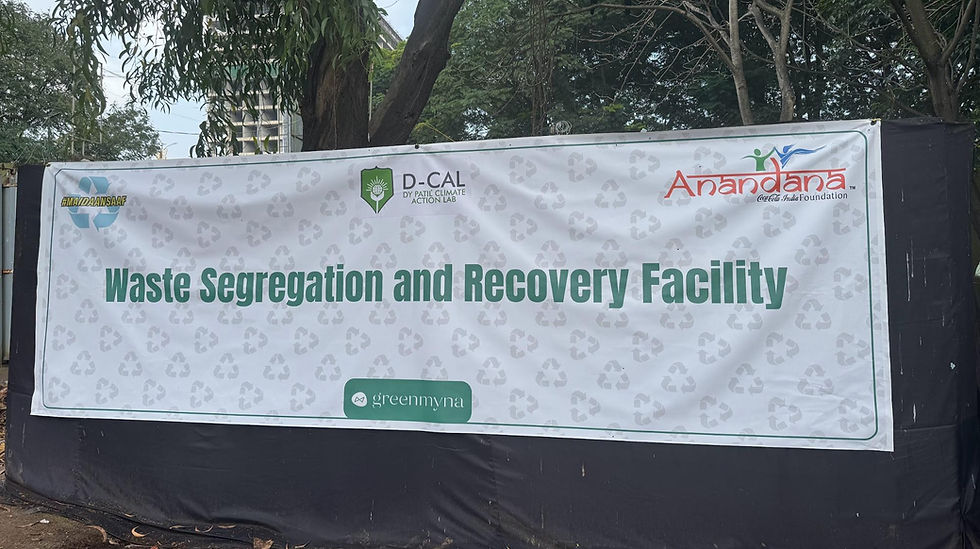
The #MaidaanSaaf initiative, led by Anandana, the Coca-Cola India Foundation, in partnership with Ek Saath – The Earth Foundation and Greenmyna, is not a sustainability communications exercise. It is an operational system running across five host stadiums and over 30 matches of the ICC Men's T20 World Cup 2026. Having worked on this on the ground, what follows is what actually works and why.
Four Streams, Not One Bin

The Solid Waste Management Rules 2026, which came into effect on April 1 this year, mandate four-stream segregation at source for bulk waste generators, wet waste (food), dry waste (plastic and paper), sanitary waste, and special care waste. At Eden Gardens and Arun Jaitley Stadium, this is happening in real time during matches, not after them.
The placement of segregation points is the decision that determines whether the system works or does not. A bin 20 metres from where a fan finishes their samosa will not get used. A clearly marked, colour-coded bin station positioned directly at the food court exit, staffed by someone who can redirect waste in real time, gets used. The infrastructure design is everything. Signage without proximity is decoration.
Volunteers Who Actually Do Something

Here is a behavioural reality that anyone who has managed waste at a live event knows: fans at cricket matches are not thinking about waste segregation. They are watching the match. Any system that depends on fan motivation alone will produce one outcome: contaminated mixed waste in every bin.
The volunteer model deployed through #MaidaanSaaf does not ask fans to be sustainability champions. It asks them to do one simple thing when someone is standing right there to guide them. Trained volunteers stationed at bin points intercept waste at the moment of disposal and redirect it to the correct stream. The segregation happens at the point of generation, not after collection. That shift, from post-collection sorting to point-of-disposal guidance, is the single most operationally significant change in how Indian cricket venues are approaching sustainable sports events.
What the 2026 implementation has confirmed: fans do not resist segregation when it is made easy and immediate. They resist it when it is confusing, inconvenient, or when no one is paying attention. The volunteer-as-nudge model addresses all three.
The People Who Actually Keep Stadiums Clean

One of the most meaningful elements of #MaidaanSaaf, and the one that gets the least coverage, is how it treats safai saathis. These are the sanitation and housekeeping workers who manage cleanliness at large venues during high-footfall events. They are also consistently the least resourced and least recognised people in the waste management chain.
#MaidaanSaaf gives safai saathis improved segregation infrastructure, structured work processes, and visible public recognition during matches. This is not a feel-good add-on. It directly improves collection efficiency and reduces contamination across waste streams because workers who understand the system and have the tools to operate it perform differently from workers who are simply told to clean up.
No waste management system at a cricket scale functions without the people running it. Building the system around them, rather than despite them, is what separates a program that works from one that looks good in a press release.
Waste That Becomes Something
The circular economy argument for cricket event waste management stops being abstract when you consider what happened at the ICC Men's Cricket World Cup 2023. Coca-Cola India supported the creation of recycled PET country flags and ICC Unity flags from post-consumer plastic collected at tournament venues. Those flags were later recognised by the Limca Book of Records. The material recovered from fans disposing of plastic responsibly during matches was waved during national anthems.
That is the circular economy made visible, and it works precisely because it is visible. At the T20 World Cup 2026, sustainable collectable beverage cups introduced at select venues extend the same principle to individual fan behaviour. Responsible consumption becomes tangible, memorable, and part of the match-day experience rather than a message on a poster near the exit.
It Is Not Just Cricket Anymore
One of the things the #MaidaanSaaf model has demonstrated clearly is that the operational framework is not sport-specific. The same system, staffed segregation stations, temporary material recovery hubs, trained volunteers, beverage consumption point recovery, was deployed at Coke Studio Bharat Live concerts in New Delhi and Guwahati, implemented by Greenmyna in partnership with Coca-Cola India.
Live music venues present a different operational challenge from cricket stadiums. Crowds move continuously. Waste generation is less predictable by zone. The fixed-seating logic that makes bin placement at cricket venues relatively straightforward does not apply when 15,000 people are moving around a standing concert floor. Adapting the system to fluid crowd dynamics, rather than simply transplanting the cricket model, is what made the Coke Studio activation work.
#MaidaanSaaf has also been activated at Ganesh Chaturthi in Mumbai, Rath Yatra in Puri, and Maha Kumbh 2025 in Prayagraj. The model scales across event formats, crowd sizes, and cultural contexts. That range of activation is what makes it a genuine event waste management framework rather than a cricket-specific operation.
What the SWM Rules 2026 Mean If You Run Any Large Event

The Solid Waste Management Rules 2026 have changed the conversation permanently for every event organiser in India. Any stadium or venue over 20,000 sqm or generating over 100 kg of waste per day is now classified as a bulk waste generator. Four-stream segregation at source is not optional. On-site processing and authorised recovery are not optional. The Polluter Pays principle means financial penalties for non-compliance, not warnings, not notices, but penalties.
For event organisers who treated waste management as something to sort out the week before the event, that approach is now a financial liability. Waste management planning has to begin at the event design stage, venue layout, food and beverage zones, entry and exit points, contractor selection, and recycler partnerships. The #MaidaanSaaf operational model at the T20 World Cup 2026 is, in effect, a compliance blueprint for every bulk waste generator in India navigating the new rules.
Conclusion
Indian cricket has spent decades building world-class playing surfaces, broadcasting infrastructure, and fan hospitality. Waste management was the part nobody talked about, until the numbers made it impossible to ignore, and the law made it impossible to avoid.
What the 2025 and 2026 tournaments have shown, on the ground, is that the system works when it is designed around how people actually behave rather than how planners wish they would. Fans will segregate waste if someone is standing there to help them. Safai saathis will run efficient collection operations if they have the right infrastructure and recognition. PET bottles will become flags if the recovery chain is in place to make it happen.
The SWM Rules 2026 have made four-stream segregation a legal requirement for every bulk waste generator in India. That is the floor. What the #MaidaanSaaf model has demonstrated across cricket, music, and cultural events is that the ceiling is considerably higher, and getting there is an operational challenge, not an ideological one.
Want to see how large-scale events get waste management right? Visit greenmyna.com for implementation resources, real-world case studies, and on-ground expertise built for event organisers, sustainability professionals, and venue operators.
Frequently Asked Questions
1. How much waste does a cricket World Cup match generate in India?
A single large match generates up to 750 kg of waste per UNEP benchmarks. At the ICC Women's Cricket World Cup 2025, DY Patil Stadium produced 63 metric tonnes across five match days, managed by 150 personnel across 78 collection points.
2. What is #MaidaanSaaf and how does it work?
It is Coca-Cola India's waste management initiative run through Anandana, implemented at the ICC Men's T20 World Cup 2026 with Greenmyna and Ek Saath- The Earth Foundation. It runs four-stream segregation at source, trained volunteers at bin points, safai saathi support, and material recovery during matches, not after.
3. What do the Solid Waste Management Rules 2026 mean for event organisers?
From April 1, 2026, venues over 20,000 sqm or generating over 100 kg of waste daily are bulk waste generators. Four-stream segregation is mandatory, authorised recovery pathways are required, and non-compliance carries direct financial penalties under the Polluter Pays principle.
4. How does India compare to global standards?
Tokyo 2020 recycled 65%, Paris 2024 targeted zero waste, and Qatar 2022 recycled over 50%. #MaidaanSaaf at the T20 World Cup 2026 now operates at a directly comparable level.
5. Does #MaidaanSaaf work for non-cricket events?
Yes. It has been deployed at Coke Studio Bharat Live concerts, Ganesh Chaturthi, Rath Yatra, and Maha Kumbh 2025, scaling across formats, crowd sizes, and cultural contexts.

Comments