

India's New 4-Stream Waste Segregation: A Complete Guide to the 2026 SWM Rules
Quick summary: India's Solid Waste Management Rules 2026 mandate four-stream waste segregation into wet, dry, sanitary and special care categories, enforce polluter pays penalties for non-compliance, and place new accountability on bulk waste generators, effective April 1, 2026, replacing the outdated 2016 framework.
Segregate waste into four streams: wet, dry, sanitary, and special care
Bulk Waste Generators include entities with 20,000+ sq. m area, 40,000+ litres/day water use, or 100+ kg/day waste
Non-compliance triggers environmental compensation under the polluter pays principle
On-site wet waste processing or an EBWGR certificate is now mandatory for bulk generators
A centralised CPCB portal tracks registration, reporting, and audits digitally
Table Of Contents
Introduction
Picture a garbage truck in any mid-sized Mumbai city on a regular Tuesday morning. Chances are, whatever gets tossed in has already been mixed by the time it leaves the street, banana peels sitting on top of a broken tube light, a used diaper somewhere in the middle, a crushed water bottle wedged in for good measure. For nearly a decade, that scene played out despite rules on paper that said it shouldn't.
India generates close to 170,000 tonnes of solid waste every single day, and historically, only around a fifth of it ever got properly treated before ending up in a landfill or open dumpsite. The 2016 rules introduced the idea of source segregation, but enforcement stayed loose enough that most infrastructure deadlines quietly slipped by. By the time anyone checked, only about a quarter of the country's waste processing facilities were even running at full capacity. The Solid Waste Management Rules, 2026, notified by the Ministry of Environment, Forest and Climate Change on January 28, 2026 and effective from April 1, 2026, exist to close that exact gap, and the biggest operational shift inside them is a mandatory four-stream segregation system that every household, office, and municipality now has to understand.
Why India Rewrote Its Waste Rules

The 2016 framework wasn't badly designed, it was badly enforced. Processing facility deadlines, sanitary landfill targets, dumpsite remediation timelines, most of it existed on paper without the accountability structure to back it up. Urban local bodies carried nearly the entire burden while the actual generators of waste, households, offices, factories, faced almost no consequence for getting it wrong.
The 2026 rules flip that arrangement. Built around circular economy principles and a genuinely enforced polluter pays structure, they shift responsibility toward whoever actually produces the waste, not just whoever is tasked with collecting it.
Mandatory Four-Stream Segregation at Source
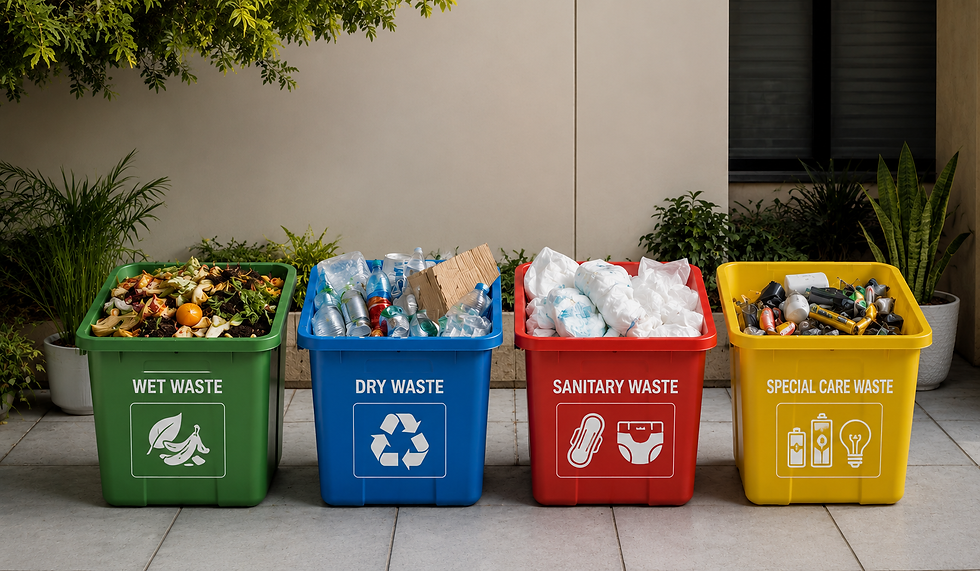
Four-stream segregation means separating waste at the point of generation into wet, dry, sanitary, and special care categories before handing it to authorised collectors.
The Four Streams
Wet waste: kitchen scraps, vegetable and fruit peels, meat, flowers, meant for composting or bio-methanation
Dry waste: plastic, paper, metal, glass, wood, rubber, routed to Material Recovery Facilities for sorting and recycling
Sanitary waste: diapers, sanitary products, tampon applicators, condoms, wrapped securely and handled separately
Special care waste: paint cans, batteries, bulbs, thermometers, expired medicines, collected only by authorised agencies or dropped at designated centres
Anyone still fuzzy on where a specific item actually belongs, particularly the everyday confusion between wet and dry categories, will find a clearer breakdown in this complete guide to dry versus wet waste segregation, which walks through real household examples.
Why Four Streams Matter
More than half of India's municipal solid waste is organic by weight. That single fact is the whole argument for why wet waste separation matters so much, since getting that one stream right unlocks the bulk of the country's composting and bio-methanation potential in one move. Plastic, meanwhile, makes up roughly 9 percent of total waste, and it only stays recyclable if it isn't contaminated by food scraps or sanitary products mixed in during collection. This is precisely why proper segregation matters so much for genuinely sustainable waste management, not as a bureaucratic checkbox, but as the actual mechanical prerequisite for recycling to work at all.
Who Must Comply? Bulk Waste Generators Explained
Defining a Bulk Waste Generator
Any entity with a floor area of 20,000 square metres or more, water consumption of 40,000 litres per day or more, or waste generation of 100 kg per day or more qualifies as a Bulk Waste Generator. That definition sweeps in large housing societies, hospitals, schools, malls, and government offices, entities that together account for close to 30 percent of the country's total waste generation.
What BWGs Are Now Required to Do
Bulk generators must collect, segregate across all four streams, store, and process their waste in an environmentally sound manner, register on the CPCB's online portal, and maintain digital compliance records rather than relying on the old physical paperwork system.
Extended Bulk Waste Generator Responsibility (EBWGR)
Where on-site wet waste processing genuinely isn't feasible, BWGs can obtain an EBWGR certificate instead, but that doesn't let them off the hook. They remain legally accountable for making sure their waste actually gets processed properly somewhere else. This one provision alone effectively moves nearly a third of the country's waste load out of pure municipal responsibility and onto the shoulders of the people producing it.
A residential society in Pune generating around 150 kg of waste daily found itself crossing into BWG territory almost by accident. Once the classification became clear, the society set up four separate bins for each stream, installed an on-site composter, trained its housekeeping staff on the new sorting system, and partnered with a local recycler to handle dry waste properly. Within three months, roughly 90 percent of the society's waste was being processed correctly instead of heading straight to landfill.
Who Handles the Waste After Segregation

Urban Local Bodies and Gram Panchayats
Local bodies remain responsible for door-to-door collection and transportation, and critically, for making sure segregated streams don't get remixed en route, which was one of the quiet failure points under the old system. They also have until March 2027 to update local bylaws around the new segregation and fee structures, and are being actively encouraged to generate carbon credits through better landfill diversion.
Material Recovery Facilities
MRFs are now formally recognised under the rules for the first time, tasked with sorting dry waste into paper, plastic, metal, and glass categories, while also doubling as drop-off points for sanitary and special care waste streams.
RDF, Landfills, and Legacy Waste Cleanup
The Refuse Derived Fuel Mandate
Cement plants and waste-to-energy facilities are now required to raise their Refuse Derived Fuel substitution rate from 5 percent to 15 percent over six years. That single shift is projected to push industrial demand for processed non-recyclable waste toward roughly 4.8 million tonnes annually from cement kilns alone by 2032, effectively turning waste processing into a genuine industrial supply chain rather than just a disposal problem.
Landfill Restrictions
Landfills are now strictly limited to non-recyclable, inert waste. Unsegregated waste attracts noticeably higher fees, deliberately priced above the cost of doing proper segregation and processing, with annual audits overseen directly by District Collectors.
Legacy Dumpsite Remediation
Existing dumpsites now require mandatory mapping, followed by time-bound biomining and bioremediation, with quarterly progress reports keeping the process visible rather than indefinitely delayed.
Special provisions apply to hilly areas and islands too, where local bodies can levy tourist user fees, regulate visitor inflow based on actual waste management capacity, and require hotels and restaurants to handle their own wet waste processing locally.
Enforcement and Penalties
The Polluter Pays Principle in Practice
Environmental compensation now applies to operating without registration, false reporting, forged documents, and improper disposal practices. CPCB sets the governing guidelines, while State Pollution Control Boards handle the actual levying of fines on the ground.
Digital Monitoring Through the CPCB Portal

A centralised online portal now tracks registration, reporting, and audit uploads across the entire waste lifecycle, replacing the old fragmented, physical reporting system with something that is at least theoretically auditable end to end.
Practical Compliance Tips
For Households
Segregate using four bins or bags, colour-coded where local rules specify, commonly green for wet and blue for dry
Compost wet waste at home using a backyard bin or a simple vermicompost pit
Rinse and flatten dry recyclables before handing them over
Wrap sanitary waste securely, ideally in newspaper or a compostable bag
Return special care items like batteries, bulbs, and expired medicines to designated drop-off points rather than the regular bin
For Municipalities
Run public awareness campaigns through posters, SMS alerts, or local apps
Provide colour-coded bins with consistent, reliable pickup schedules
Partner with MRFs and composting or biogas operators for proper downstream processing
Update bylaws ahead of the March 2027 deadline and enforce EBWGR compliance among local bulk generators
For Businesses and Bulk Waste Generators
Install a clearly labeled four-bin system with assigned staff oversight
Set up on-site composters or bio-digesters where feasible, particularly for hostels, restaurants, and large kitchens
Register on the CPCB portal and maintain digital compliance logs
Run periodic waste audits, weighing segregated categories to track compliance trends over time
Comparative Snapshot: SWM Rules 2016 vs 2026
Parameter | SWM Rules 2016 | SWM Rules 2026 | Impact |
Segregation Streams | Wet, dry, domestic hazardous (3 streams) | Wet, dry, sanitary, special care (4 streams) | Cleaner recyclables, reduced contamination |
Generator Accountability | Primarily municipal responsibility | EBWGR certificates with shared legal liability | Cost internalisation for large generators |
Monitoring | Physical, fragmented reporting | Centralised CPCB online portal | End-to-end digital audit trail |
Enforcement | Weak penalty mechanisms | Environmental compensation under polluter pays | Real financial deterrent |
Landfill Rules | General restrictions, deadline-based | Strict limits to inert waste and higher unsegregated fees | Stronger landfill diversion incentive |
Conclusion
The SWM Rules 2026 represent a major shift in India's approach to waste management, moving it from being primarily a municipal responsibility to a shared legal obligation involving households, businesses, institutions, and local authorities. With stricter segregation requirements, digital monitoring mechanisms, and increased accountability for Bulk Waste Generators (BWGs), compliance will increasingly depend on preparation rather than reaction.
For organizations that fall under the BWG category, this is an ideal time to assess current waste management practices, conduct a baseline waste audit, and implement a proper four stream segregation system before regulatory deadlines become more stringent. Early action can help reduce operational disruptions, improve sustainability performance, and ensure smoother compliance as the new framework is rolled out.
Beyond regulatory compliance, the updated rules also present an opportunity to build more resource efficient and environmentally responsible operations.
Preparing for SWM Rules 2026? Partner with Greenmyna to simplify compliance, implement
effective waste management systems, and build a more sustainable future.
FAQs
1. What exactly is four-stream segregation under SWM Rules 2026?
Waste must be separated at source into wet (organic), dry (recyclables), sanitary, and special care (hazardous) categories before being handed to authorised collectors.
2. Who qualifies as a Bulk Waste Generator?
Any entity with 20,000 square metres or more of floor area, 40,000 litres per day or more of water use, or 100 kg per day or more of waste generation, covering large housing societies, hotels, malls, and institutions.
3. What is Extended Bulk Waste Generator Responsibility (EBWGR)?
If a bulk generator cannot process wet waste on-site, it must obtain an EBWGR certificate and remain legally accountable for ensuring the waste is properly processed elsewhere.
4. How are violations of the new rules penalized?
Through the polluter pays principle, State Pollution Control Boards levy environmental compensation for unregistered operation, false reporting, illegal dumping, and unsegregated waste disposal.
5. When do these rules actually need to be followed?
The rules took effect April 1, 2026, with an 18-month compliance window for the largest cities, 24 months for mid-sized cities, and 36 months for smaller towns, though segregation is expected to begin immediately regardless of city size.


Comments