

Eco-Friendly Godh Bharai Decoration Ideas at Home
Quick answer: An eco-friendly godh bharai swaps balloons and plastic bunting for marigold garlands, fabric drapes, and terracotta diyas, skips single-use tableware, and sends guests home with plantable or handmade return gifts instead of trinkets. It costs the same or less than a conventional setup and suits a simple home celebration just as well as a larger one.
Table Of Contents
Key takeaways
Latex balloons marketed as "biodegradable" don't meaningfully break down. A 2020 peer-reviewed study found no real degradation after sixteen weeks in freshwater, saltwater, or industrial compost
Marigold, fabric drapes, and terracotta diyas cost the same or less than balloon and plastic bunting setups
A simple home setup needs almost none of what decorator sites push. A fabric backdrop and fresh flowers cover most of the visual impact on their own
Return gifts are where the most waste usually piles up after the event ends, and they're the easiest thing on this list to fix
None of this involves giving anything up. The traditional version of this ceremony was already largely plastic-free
Introduction

There's a familiar scene that plays out before most godh bharai celebrations: someone in the family heads out to buy balloons, because they're the fastest way to fill a room with colour, and a decorator hasn't been booked. It's a reasonable instinct. It's also worth pausing on, because those balloons, even the ones sold as biodegradable, turn out to be one of the more stubborn kinds of plastic waste a home celebration can produce, and that's not an opinion, it's something researchers have actually tested.
This piece covers a simple, realistic home setup, what's worth leaving out entirely and why, and return gifts guests will genuinely keep rather than bin on the way out.
What Makes a Godh Bharai Eco-Friendly?
Three things, in order of how much they matter: the materials used (natural, reusable, or genuinely compostable, not just labelled that way), the flowers (fresh and locally sourced rather than shipped in), and the disposables, or rather, the near-total absence of them. Get those three right and the rest of the setup mostly takes care of itself.
Natural and Reusable Decor: Marigold, Fabric Drapes, Terracotta Diyas
Marigold and fresh flower garlands. Strung fresh from a local market, marigold and mogra do more visual work than any plastic garland manages, and they're the traditional choice for a reason, this ceremony has used real flowers for generations, long before synthetic alternatives existed. Sourcing locally matters more than most decor guides mention: a marigold farm a short drive away has a fraction of the footprint of a flower shipped in from elsewhere, and it looks fresher on arrival too. Greenmyna's guide to local flowers for Indian weddings makes this case in detail for wedding decor, and the same logic applies directly here.
Fabric drapes as a backdrop. An old saree, a dupatta that hasn't been worn in a while, or a dohar pulled from a cupboard makes a richer, more textured backdrop than a printed vinyl panel bought for one afternoon, and it costs nothing at all.
Terracotta diyas and brass or copper accents. Unpainted clay diyas, alongside brass or copper vessels already sitting in most Indian homes, add warmth and shine without a single new purchase. These materials were part of this ceremony long before synthetic decor showed up as a shortcut, using them isn't a compromise, it's closer to the original version.
Budget-Friendly Simple Setups for Home

Most of what a paid decorator delivers for a godh bharai comes down to three things: a backdrop, some flowers, and warm lighting. All three are achievable in an afternoon with no vendor involved at all. One fabric backdrop hung behind the seating area, one generous flower garland, and a cluster of diyas or a reused string of warm-white LED lights cover most of the visual impact a full setup provides. A clean, decluttered room does more for the overall look than people tend to expect, half the effect of any decorated space comes from what's been removed, not what's been added. None of this requires special sourcing. Most of it is already somewhere in the house. Greenmyna's broader guide on eco-friendly party decorations covers this same principle, less volume, more intention, applied across home celebrations generally.
What to Avoid: Balloons, Plastic Bunting, and Single-Use Tableware
The balloon problem, and why "biodegradable latex" doesn't hold up. This is worth explaining properly, because it contradicts what most packaging claims. In 2020, researchers at the Institute for Marine and Antarctic Studies (University of Tasmania) tested latex balloons in freshwater, saltwater, and industrial compost over sixteen weeks, published in the Journal of Hazardous Materials. The result: no meaningful degradation in any of the three environments. The "biodegradable" label on latex balloon packaging doesn't reflect how they actually behave once they're in the world. Separately, a 2019 study led by marine scientist Lauren Roman, examining the deaths of 1,733 seabirds across 51 species and published in the journal Scientific Reports, found that balloon fragments were roughly 32 times more likely to kill a seabird than a piece of hard plastic, soft plastics like balloons made up only about 5 percent of what the birds had ingested, yet accounted for more than 40 percent of the deaths. Closer to home, reporting on India's own stray-animal plastic problem has documented cattle in Indian cities found with balloon and plastic fragments in their stomachs, an extension of the well-known issue of urban cows ingesting plastic waste generally.
Mylar balloons are worse, not better. Foil-style mylar balloons don't decompose at all, being made from a metallic-coated plastic film, and they carry the added risk of causing power outages if they drift into electrical lines.
Plastic bunting and single-use tableware. These need less explanation, the waste is direct and immediate. Paper bunting, reusable cloth banners, and reusable or compostable serveware cover the same ground without leaving anything behind once the celebration ends.
Eco-Friendly Return Gift Ideas for Guests
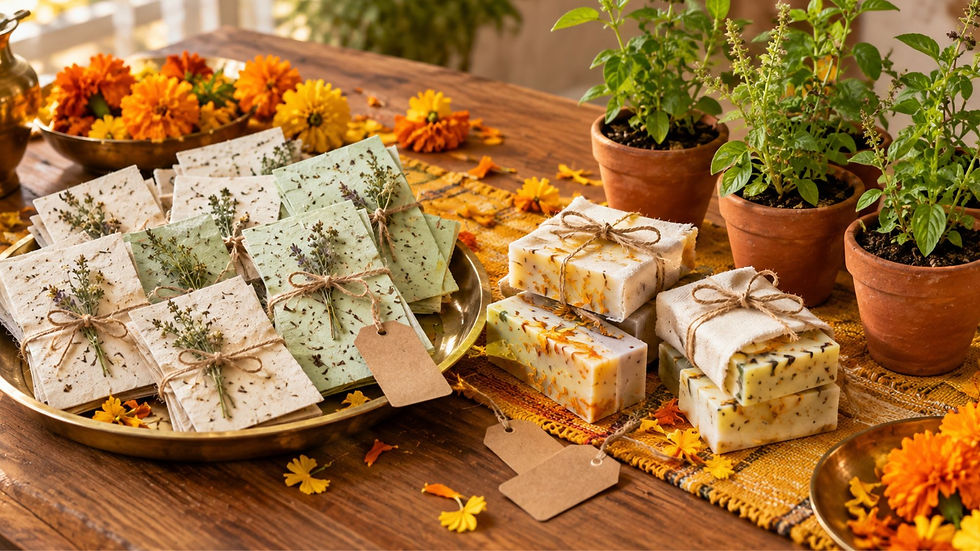
Return gifts are where waste tends to pile up quietly after everyone's gone home, small plastic trinkets that get glanced at once and then forgotten in a drawer. Plantable seed paper favors, handmade soap, or a small potted plant give guests something to actually use or grow instead. Greenmyna's guide to plantable seed paper gifts covers exactly this in more depth, including one detail worth knowing in advance: seed paper favors germinate less reliably if they sit in storage somewhere warm and humid for months, so ordering closer to the event date, rather than far ahead of it, matters more than it seems like it should.
Conventional vs. Eco-Friendly Godh Bharai Decor
Element | Conventional | Eco-Friendly Swap | Real Impact |
Balloons | Latex or mylar balloon clusters | Marigold garlands, fabric drapes | Avoids waste that doesn't meaningfully degrade |
Backdrop | Printed vinyl or plastic panel | Old saree, dupatta, or dohar | Zero cost, zero landfill waste |
Lighting | Disposable fairy lights | Terracotta diyas or reused LED strings | Reusable across future events |
Tableware | Single-use plastic plates and cups | Reusable or compostable alternatives | No post-event plastic waste |
Return gifts | Plastic trinkets, synthetic favors | Seed paper, handmade soap, small potted plants | Guests keep or plant them instead of discarding |
A Practical Framework
Before decorating, check what's already at home. A saree or dupatta for a backdrop, brass or copper items for accents, most of the setup costs nothing.
For flowers, source locally rather than ordering online. Fresher, and a smaller footprint either way.
Skip balloons entirely. If they feel non-negotiable for the occasion, keep the count minimal and dispose of them properly rather than letting them drift outdoors.
For return gifts, order closer to the event date and choose something a guest will actually use or plant, not something that ends up in the bin with the rest of the party waste.
The Bottom Line
The single biggest change a home godh bharai can make isn't adding anything new to the setup. It's leaving balloons out and replacing them with what this ceremony traditionally used anyway, marigold, fabric, clay, brass. None of it is a downgrade, and most of it costs less than what it's replacing.
Planning something bigger around the same idea, a full home function or something closer to a proper event? Greenmyna's guide to eco-friendly party decorations carries these same principles further, less volume, more intention, without losing any of the occasion's colour.
Frequently Asked Questions
1. What are simple eco-friendly decoration ideas for godh bharai at home?
A fabric backdrop using an existing saree or dupatta, a fresh marigold garland, and a cluster of terracotta diyas or reused LED lights cover most of the setup without buying anything new
2. Are biodegradable latex balloons actually eco-friendly?
Not meaningfully. A 2020 peer-reviewed study found latex balloons showed no real degradation after sixteen weeks in freshwater, saltwater, or industrial compost, despite common "biodegradable" marketing claims.
3. What can be used instead of balloons for a godh bharai?
Marigold garlands, fabric drapes, and terracotta diyas provide the same colour and festive feel without the plastic waste balloons leave behind.
4. What are good eco-friendly return gift ideas for godh bharai guests?
Plantable seed paper favors, handmade soap, or small potted plants give guests something to use or grow, instead of a trinket that ends up in the bin.
5. Can a godh bharai be decorated at home without a professional decorator?
Yes. A fabric backdrop, fresh flowers, and diyas or reused string lights deliver most of the visual effect a paid setup provides, at a fraction of the cost.


Comments