

What Is Corporate Sustainability ?
Updated: Aug 12
Key Takeaways:
Corporate sustainability means centers on balancing profit with environmental protection, social welfare, and ethical governance, not treating them as separate concerns.
In India, SEBI's Business Responsibility and Sustainability Reporting (BRSR) framework now requires top listed companies to disclose detailed ESG metrics, alongside the National Guidelines on Responsible Business Conduct (NGRBC).
90% of S&P 500 companies globally now release ESG reports, and 76% of executives say sustainability is central to business strategy.
Common corporate sustainability goals are tracked through practical KPIs, carbon emissions, energy and water usage, waste reduction, employee diversity and retention, and ethical supply-chain performance.
Despite strong structural adoption, a notable share of CEOs are publicly deprioritizing "ESG" branding in 2026, even as underlying reporting obligations keep expanding in both India and globally.
Table Of Contents
Introduction

So, what is corporate sustainability, and why has it moved from a niche concern to a boardroom, and boardroom-adjacent regulatory imperative? Corporate sustainability is a business strategy that manages long-term environmental, social, and economic health, built on three core pillars: environmental responsibility (reducing carbon footprint and waste), social responsibility (fair labor and community impact), and governance (ethical leadership and transparent reporting). In India, this shift is being driven by stronger environmental regulations, growing investor awareness, and global sustainability frameworks reshaping how companies operate, grow, and stay competitive.
From large corporations to emerging startups, Indian businesses are increasingly recognizing that sustainable practices aren't just about environmental responsibility, they also support long-term profitability, brand reputation, and operational efficiency. Globally, the picture is similar but more mature: 90% of S&P 500 companies now publish ESG or sustainability reports, and 76% of executives say sustainability is central to business strategy. Yet even as formal reporting and compliance obligations expand, some executives are publicly cooling on "ESG" as a marketing term, a nuance worth understanding if you're building a sustainability strategy for 2026.
This guide explains the corporate sustainability meaning in practical terms, the major ESG frameworks businesses in India and globally must understand, how to set and measure corporate sustainability goals, and the steps companies can take to build a genuinely sustainable strategy.
What Is Corporate Sustainability?
Corporate sustainability refers to the way a company manages its operations while balancing economic growth, environmental protection, and social responsibility. Rather than focusing only on short-term profits, sustainable organizations aim to create long-term value for both their stakeholders and society.
It's about operating a business in a way that safeguards resources and wellbeing for future generations, implementing eco-conscious practices that minimize pollution, conserve resources like water and energy, protect biodiversity, and mitigate climate change, while also fostering ethical labor practices, human rights, diversity and inclusion, and positive community impact. Corporate sustainability isn't a short-term fad; it's a fundamental shift in how businesses operate, positioning companies for long-term resilience and enduring value, regardless of which political winds are blowing around the term "ESG" in any given year.
The Three Pillars of Corporate Sustainability
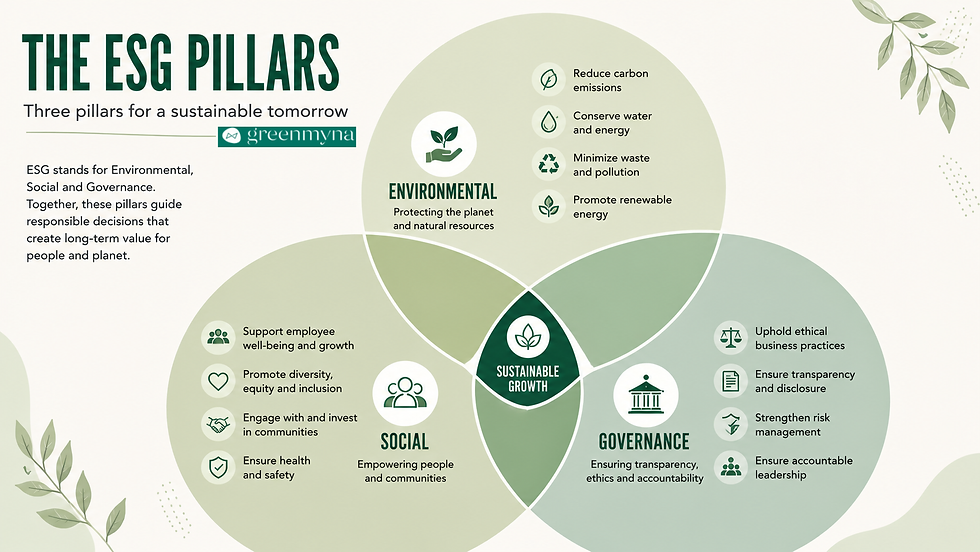
A robust corporate sustainability framework generally rests on three key pillars:
1. Environmental Responsibility This pillar focuses on reducing the environmental footprint of business operations, cutting down greenhouse gases, using green energy, and preventing pollution. Indian companies increasingly invest in waste reduction programs, carbon footprint management, sustainable packaging, and resource-efficient production processes. Globally, this looks similar: think of a company transitioning to renewable energy, implementing recycling programs, or developing eco-friendly packaging. S&P 500 companies' average water withdrawal intensity fell 12% between 2019 and 2022, showing measurable progress is achievable at scale.
2. Social Responsibility This pillar focuses on how businesses interact with employees, communities, and customers, promoting safe workplaces, fair wages, and inclusive community ties. Organizations strengthen social responsibility through fair labor policies, community engagement programs, employee health and safety initiatives, and ethical supply-chain practices. A strong social commitment often improves employee retention, brand reputation, and stakeholder trust.
3. Governance Governance ensures honest management, clear risk rules, and audit-ready data across the organization. Good governance practices typically include ESG reporting and disclosures, ethical procurement, strong corporate governance policies, and risk management frameworks. Notably, 25% of S&P 500 companies now tie ESG metrics directly to executive compensation, reflecting how governance increasingly enforces accountability for the other two pillars.
Together, these three pillars form the foundation of ESG: Environmental, Social, and Governance.
Why Corporate Sustainability Matters Now?
Strict Rules: Global frameworks like the EU's Corporate Sustainability Reporting Directive (CSRD) now require audited ESG data from thousands of firms. In India, regulators have moved in a similar direction, SEBI's Business Responsibility and Sustainability Reporting (BRSR) framework now requires many top listed companies to disclose detailed ESG performance indicators, with reporting requirements gradually expanding.
Growing Investor Focus: Investors are increasingly weighing ESG performance when evaluating companies. Businesses that demonstrate strong sustainability practices are more likely to attract ESG-focused investment funds, impact investors, and institutional investors seeking responsible portfolios, a trend visible both in India and globally, where 75% of investment professionals say a company's sustainability performance factors into investment decisions.
Changing Customer Expectations: Consumers today are more environmentally conscious than ever, and buyers and investors increasingly favor honest, verified eco-friendly companies over greenwashed claims. Companies that prioritize genuine sustainability often see stronger brand credibility, higher customer loyalty, and clearer differentiation in competitive markets. Roughly 28% of a brand's overall value is now linked to its reputation for corporate responsibility.
Cost Control: Saving energy and reducing material waste lowers long-term operational expenses. Energy-efficient operations cut electricity costs, waste reduction lowers disposal costs, and resource optimization improves productivity, efficiencies that compound significantly over time.
Risk Management: Climate change, resource scarcity, and social unrest are growing threats. 84% of S&P 500 companies now formally identify climate change as a financial risk, up sharply from 67% in 2021, showing this has moved from a reputational concern to a core risk-management issue.
Key ESG Regulations and Frameworks
To implement corporate sustainability effectively, businesses need to understand the frameworks shaping ESG reporting, both in India and globally.
In India:
Business Responsibility and Sustainability Reporting (BRSR): Introduced by SEBI, BRSR requires India's top listed companies to disclose detailed ESG metrics covering environmental performance, employee well-being, governance practices, and responsible supply-chain management. BRSR reporting is gradually becoming a core requirement for large Indian companies. Learn more about what Indian businesses must do to stay ESG compliant in 2026.
National Guidelines on Responsible Business Conduct (NGRBC): NGRBC provides nine principles encouraging responsible business behavior, covering ethical governance, environmental stewardship, and inclusive development. Companies often use these guidelines as a foundation for building their sustainability strategy.
Globally:
CSRD, CSDDD, and SFDR (EU): These frameworks are narrowing in scope but deepening in requirements for companies still covered, creating a more rigorous, if more selective, compliance bar.
IFRS S2: Increasingly the global reference point for climate-related financial disclosures, linking regional frameworks like CSRD to a more consistent international baseline.
Global Reporting Initiative (GRI), UN Sustainable Development Goals (SDGs), and SASB: Many Indian and global businesses align with these standards to strengthen sustainability reporting and meet international investor expectations.
How Businesses Can Implement Corporate Sustainability

Developing a sustainability strategy requires a structured, practical approach.
Step 1: Conduct a Sustainability Assessment Understand your organization's current environmental and social impact by assessing waste generation and disposal practices, energy consumption patterns, carbon emissions, and supply-chain sustainability. This evaluation helps identify the most important improvement opportunities.
Step 2: Develop an ESG Strategy A strong strategy includes defined ESG goals, measurable sustainability KPIs, implementation timelines, and monitoring and reporting mechanisms. Having measurable targets helps organizations track progress and maintain accountability.
Step 3: Strengthen Waste Management Systems Waste management remains one of the most significant sustainability challenges for businesses. Companies can adopt waste segregation systems, recycling programs, organic waste composting, and zero-waste workplace initiatives to reduce environmental impact and improve regulatory compliance.
Step 4: Adopt Circular Economy Practices Circular economy models focus on minimizing waste by keeping materials in use for as long as possible, reusing industrial by-products, recycling packaging materials, converting organic waste into compost, and designing products for reuse or recycling. Circular strategies help companies reduce costs while supporting environmental sustainability. Explore how Greenmyna supports businesses through hands-on sustainability engagements if you're looking for practical implementation support.
Corporate Sustainability Goals and KPIs: How to Measure What Matters
Talk is cheap, when it comes to corporate sustainability, it's not enough to just say you care. Companies need to set measurable corporate sustainability goals, track progress with concrete KPIs, and report results transparently. That's where frameworks like the UN SDGs, GRI, and IFRS S2 come in, but frameworks alone aren't enough. Businesses also need practical, trackable metrics that map directly to day-to-day operations.
Practical KPIs for Corporate Sustainability Goals
Environmental KPIs:
Carbon emissions: Scope 1, 2, and increasingly Scope 3 greenhouse gas emissions, typically measured in tons of CO2 equivalent.
Energy consumption: Total energy use and the share sourced from renewables, tracked per facility or per unit of output.
Water usage: Water withdrawal and consumption intensity, especially critical for water-stressed regions and manufacturing-heavy operations.
Waste reduction: Volume of waste generated, percentage diverted from landfill through recycling or composting, and progress toward zero-waste targets.
Social KPIs:
Employee diversity: Representation across gender, background, and leadership levels, tracked against defined inclusion targets.
Employee retention: Turnover rates and engagement scores, which double as an indicator of workplace culture and social sustainability.
Ethical supply-chain performance: Percentage of suppliers audited for labor practices, human rights compliance, and environmental standards.
Setting targets against these KPIs, for example, "reduce Scope 1 and Scope 2 emissions by 30% below 2025 levels by 2030", gives sustainability efforts clarity and direction, while also making it far easier to demonstrate genuine progress to regulators, investors, and customers rather than relying on vague commitments.
Why Measurable Corporate Sustainability Goals Matter
Clarity and Focus: Specific, KPI-based targets give sustainability efforts direction and motivate teams.
Accountability: Measurable goals make it clear whether a company is on track or falling behind, crucial for maintaining credibility with regulators and investors.
Investor Appeal: Sustainable global assets under management are projected to reach roughly $50 trillion, and investors increasingly expect KPI-backed evidence, not just narrative claims.
Example of Sustainable Goal Setting
Scope | Topic | Baseline | Target | Framework Alignment |
Environmental | Greenhouse Gas Emissions | In 2025, total Scope 1 and Scope 2 emissions were [Insert Metric] tonnes of CO₂ equivalent. | Reduce Scope 1 and Scope 2 emissions by 30% below 2025 levels by 2030. | UN SDG 13, Paris Agreement, IFRS S2, BRSR |
Social | Employee Retention | The voluntary employee attrition rate in 2025 was [Insert Metric]%. | Reduce voluntary attrition to below [Target]% by 2027 through improved workplace practices. | NGRBC Principle 3, GRI 401 |
Governance | Supplier Audits | [Insert Metric]% of key suppliers were audited for ethical practices in 2025. | Achieve 100% audit coverage of key suppliers by 2028. | BRSR, NGRBC Principles |
Benefits of ESG Adoption for Businesses

Organizations that actively integrate ESG principles often experience several long-term benefits:
1. Stronger Brand Reputation: Transparent sustainability initiatives build greater trust among customers, investors, and employees.
2. Better Regulatory Compliance: Implementing ESG practices helps organizations stay aligned with evolving sustainability regulations, whether that's BRSR in India or CSRD in the EU.
3. Improved Operational Efficiency: Sustainable operations typically use resources more efficiently, leading to meaningful cost reductions.
4. Increased Investor Interest: Many investors actively seek companies with strong ESG performance, creating new opportunities for capital, 71% of C-suite leaders say ESG investment gives their company a genuine competitive advantage.
Corporate Sustainability Trends in India and Globally (2026)
Carbon Neutrality Goals: Many companies, in India and globally, are committing to net-zero emissions targets as part of their climate strategies.
Sustainable Supply Chains: Businesses are placing greater emphasis on responsible sourcing and environmentally friendly logistics.
Waste-to-Resource Innovations: Organizations are exploring ways to convert waste into useful resources, compost, recycled materials, or renewable energy.
ESG Technology Platforms: Digital tools are helping companies track sustainability metrics, measure emissions, and generate ESG reports, with demand for professionals who can connect sustainability with finance, risk management, and data analytics expected to grow through 2026.
Political Divergence on "ESG" Branding: In some global markets, particularly the US, the term "ESG" itself is fragmenting amid political and reputational pressure, even as underlying reporting obligations expand. India's regulatory trajectory, by contrast, continues to move steadily toward deeper mandatory disclosure through BRSR.
Challenges Businesses Face in Implementing Sustainability
Despite its growing importance, implementing sustainability initiatives presents real challenges:
Limited Awareness: Many organizations, especially smaller businesses, still have limited awareness of ESG frameworks and where to start.
Initial Investment Costs: Sustainability infrastructure, from renewable energy systems to waste management upgrades, requires upfront capital.
Complex Reporting Requirements: Navigating BRSR, NGRBC, and international frameworks simultaneously can be genuinely difficult for companies operating across markets.
Data Quality and Coverage Gaps: This has become one of the sharpest global challenges, a large share of investors cite ESG data coverage gaps and inconsistent data quality as major obstacles, and many finance teams still don't formally report on ESG metrics at all.
Potential for Greenwashing: Some companies talk a big game about sustainability without truly walking the walk, eroding trust and, increasingly, inviting regulatory scrutiny.
Many organizations address these challenges by working with sustainability consultants and ESG solution providers who offer ESG consulting, corporate waste management solutions, carbon footprint analysis, sustainability reporting, and circular economy solutions to help implement practical, scalable programs.
A Unique Perspective: Collaborative Innovation for Sustainability
The most impactful corporate sustainability efforts aren't undertaken in isolation. Sustainability works best as a springboard for collaboration and innovation:
Partnerships: Companies working with suppliers, distributors, or even competitors can achieve larger-scale sustainability goals, for example, collaborating on a more sustainable shared supply-chain alternative.
Stakeholder Engagement: Actively seeking input from employees, customers, and communities allows companies to address genuine concerns and tailor sustainability efforts to specific needs.
Embracing Technology: Data analytics, AI, and other emerging technologies are increasingly central to the sustainability toolbox, from using data to identify efficiency improvements to AI-powered carbon accounting and waste management solutions.
Corporate Sustainability vs. Corporate Social Responsibility
While often used interchangeably, corporate sustainability and corporate social responsibility (CSR) have distinct meanings and scopes:
Corporate sustainability meaning: A broad, holistic approach to business that prioritizes long-term environmental, social, and economic well-being, integrating responsible practices into the core of a company's operations.
Corporate Social Responsibility (CSR) meaning: A key component of corporate sustainability, CSR focuses on a company's ethical obligations toward society and the environment, often through philanthropy, volunteerism, and environmentally conscious practices.
Feature | Corporate Sustainability | Corporate Social Responsibility (CSR) |
Scope | Encompasses all aspects of a company's operations with a focus on long-term environmental, social, and economic impact. | Focuses on specific social and environmental initiatives undertaken by the company. |
Focus | Prioritizes transforming the business model to improve resilience, create long-term value, and minimize negative impacts. | Emphasizes ethical behavior, community engagement, and social responsibility, often beyond legal requirements. |
Integration | Embeds responsible practices into core business strategy and day-to-day decision-making. | May operate as standalone programs or within a dedicated CSR or sustainability department. |
Relationship | CSR is a key component within the broader corporate sustainability framework. | A truly sustainable company incorporates CSR principles while aligning its entire business model with long-term positive impact. |
The Future of Corporate Sustainability in India
India is steadily moving toward a more sustainable economic model. Government policies like BRSR and NGRBC, investor expectations, and rising consumer awareness are all pushing businesses toward responsible practices. Organizations that integrate corporate sustainability into their strategy today, with clear goals, real KPIs, and genuine transparency, will be better positioned to succeed as regulation deepens and investor scrutiny increases. Companies that lead in ESG adoption are likely to become the innovators and market leaders of the future, in India and globally.
Conclusion: The Future Is Sustainable
The journey toward corporate sustainability is ongoing, and 2026 has made clear it's also increasingly complex, shaped by deepening regulation in markets like India and the EU, political pushback in others, and a growing gap between public rhetoric and reporting reality. But the underlying rewards still outweigh the challenges. Businesses that embrace corporate environmental sustainability substantively, not just rhetorically, aren't just doing what's right for the planet and society, they're positioning themselves for a more resilient, defensible future.
By setting measurable corporate sustainability goals, prioritizing transparency, embracing innovation, and seeking collaboration, companies can reap the benefits of a genuinely sustainable model: a stronger reputation, happier employees, increased resilience, and lasting value for the world around them.
Let's Build a Sustainable Future, Together
If you're ready to embark on your corporate sustainability journey or need guidance refining your existing strategy, Greenmyna is here to help. From ESG consulting to hands-on sustainability engagements, let us be your partner in creating a better world, one sustainable business at a time. Contact us today!
FAQs
1. What is corporate sustainability?
Corporate sustainability is a business strategy that manages long-term environmental, social, and economic health. It's built on three pillars, environmental responsibility, social responsibility, and governance, and focuses on creating long-term value for stakeholders rather than just short-term profit.
2. What is corporate sustainability in simple terms?
In simple terms, corporate sustainability meaning comes down to running a business in a way that doesn't just chase short-term profit, but also protects the environment, treats people fairly, and operates with honest, transparent governance, for the long haul.
3. What is the measurement of sustainability?
Sustainability is measured using environmental, social, and governance (ESG) metrics, typically aligned with frameworks like the UN SDGs, GRI, IFRS S2, or India's BRSR. Practical KPIs include carbon emissions, energy consumption, water usage, waste reduction, employee diversity, employee retention, and ethical supply-chain performance.
4. How do you set effective corporate sustainability goals?
Effective corporate sustainability goals are specific, measurable, and time-bound, for example, reducing Scope 1 and 2 emissions by a set percentage by a target year. They should be tracked using concrete KPIs, aligned with recognized frameworks, and reported transparently to maintain accountability.
5. What are the 3 elements of corporate sustainability?
The three elements, or pillars, are Environmental Responsibility (reducing environmental footprint), Social Responsibility (fair labor and community impact), and Governance (ethical leadership and transparent reporting).
6. What is corporate environmental sustainability?
Corporate environmental sustainability is the environmental pillar of corporate sustainability specifically, a company's efforts to reduce its environmental footprint through cutting greenhouse gases, adopting green energy, preventing pollution, managing waste responsibly, and conserving resources like water and energy.
7. Why is corporate sustainability important?
It's important because it enhances brand reputation, supports talent acquisition and retention, reduces costs through efficiency, manages emerging risks like climate change, and is linked to stronger long-term profitability and lower cost of capital.
8. What is the CSR sustainability concept?
CSR (Corporate Social Responsibility) is a component of the broader corporate sustainability concept, focused specifically on a company's ethical obligations toward society and the environment, often through philanthropy, volunteerism, and responsible business practices.
9. What is an example of corporate sustainability?
A company switching to renewable energy sources, implementing a zero-waste program, tying executive compensation to ESG metrics, or establishing a supplier code of conduct focused on fair labor practices are all examples of corporate sustainability in action.
10. What ESG regulations apply to Indian businesses?
Indian businesses are primarily governed by SEBI's Business Responsibility and Sustainability Reporting (BRSR) framework, which requires top listed companies to disclose detailed ESG metrics, alongside the National Guidelines on Responsible Business Conduct (NGRBC). Many Indian companies also align with global frameworks like GRI and the UN SDGs to meet international investor expectations.
11. Is corporate sustainability still a priority for companies in 2026?
It's a mixed picture globally. Structurally, sustainability reporting continues to expand, 90% of S&P 500 companies now publish ESG reports, and frameworks like BRSR in India and CSRD in the EU are deepening requirements. At the same time, some CEOs, particularly in the US, are publicly deprioritizing "ESG" as a stated 2026 focus amid political pressure. In practice, this means the underlying work continues even as public messaging becomes more selective, and in India specifically, the regulatory trajectory remains firmly toward deeper mandatory disclosure.



Comments